Older Florida homes have a certain charm, but the plumbing does not always age gracefully. If you keep chasing leaks, dealing with rusty water, or losing pressure at the worst times, it may be your house telling you the plumbing is beyond repair. At Snowbird Heating & Cooling, we help you figure out whether repiping is the right move or if a pipe repair still makes sense.
When One Leak Becomes a Pattern You Can’t Ignore
A single leak can be bad luck. A second leak in a different spot can still be a fluke. When leaks start rotating through the house, things are going badly. Recurring leaks also change how you use your home. You stop trusting the plumbing when you leave for the weekend.
Repiping makes sense when your repair history shows the whole piping system failing in multiple locations, not just one isolated section. That is when money goes into repeat visits, repeat holes in walls, and repeat stress, instead of into a fresh start that removes the weak pipe from the equation.
Rusty Water, Metallic Taste, and Clogged Fixtures
If you notice brown water or rust-colored staining in tubs and toilets, you’re likely seeing corrosion inside older metal pipes. You might also notice a metallic taste or odor that appears only in hot water.
Faucets and showerheads can clog more often because small bits of scale break loose and ride the flow. At first, you may think it is the fixture, so you replace the aerator or swap the showerhead. Then the next one clogs. Then the next.
Persistent clogs also point to a more serious underlying issue. In older homes, galvanized pipes can also narrow from the inside, like a straw closing up. You still get water, yet the diameter loss reduces flow and can make the pressure feel weak at the far end of the house.
When discoloration and clogging keep happening, repiping becomes less about aesthetics and more about restoring a clean, stable water path.
Unexpected Water Pressure Drops
Low pressure can come from many places, yet older piping creates a specific kind of frustration. You start a shower, and it runs fine. Then you turn on the kitchen sink, and the shower turns into a trickle. You run the dishwasher, and suddenly the bathroom faucet feels weak. You may also notice uneven pressure room to room, where one bathroom feels normal and another feels like it is running through a pinched hose.
A corroded pipe can restrict flow, preventing the system from keeping up when multiple fixtures are in use. Old fittings can narrow as well, especially where repairs have accumulated over the years. Pressure can also swing when pipe interiors shed scale, which can shift and partially block small passages.
The pattern matters. If pressure loss happens only at one fixture, that’s where you likely need the repair. If the issue appears across several rooms and worsens when the house is running water in two places, the problem is often in the distribution lines.
Pipe Materials That Age Poorly in Many Older Homes
Older homes can have a mix of materials, sometimes from different remodel eras:
- Galvanized steel pipes can rust and narrow over time.
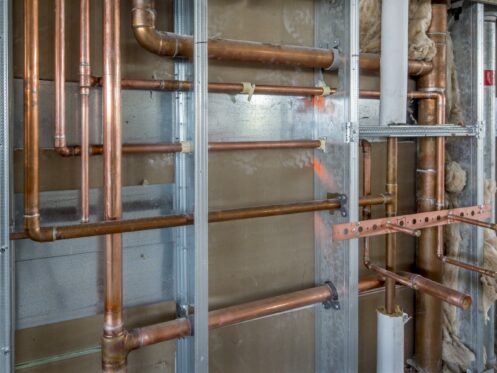
- Copper pipes can last a long time, but hard water can cause scale buildup, corrosion, and pinhole leaks.
- Polybutylene pipes can fail at fittings and along runs, creating a seemingly random leak pattern that never settles down.
You can also find patched sections where a prior repair introduced a new material connected to the old pipe, creating multiple connection points that must remain tight.
Pipe Layout
Pipe material and age are not the only factors. Layout matters, too. Pipes routed through attics can see big seasonal swings. Pipes in exterior walls can cool fast during cold snaps. Pipes under the slab can leak where they aren’t visible, allowing damage to spread before it is detected.
When considering repiping, consider both the pipe’s material and its location in the house. If your plumbing has reached the stage where one material failure leads to another, a whole-house repiping can prevent you from replacing small pieces forever while the weakest sections wait their turn.
When Repairs Start Damaging the House More Than the Pipe
At some point, the repair cycle becomes a problem in itself. Each leak repair can mean drywall cuts, cabinet removal, tile disruption, or flooring damage. Even with careful work, repeated openings leave your house looking patched. You repaint one wall, then two months later, a different wall gets opened. You replace a vanity, then a leak appears behind the other bathroom sink, and you hesitate to upgrade anything because you don’t trust what will happen next.
You can also end up with a system that is repaired in pieces but never feels stable. One section is new, another is old, and the transition fittings are in areas that are difficult to access.
You may be spending money on the same type of repair repeatedly, with the same stress each time. Repiping becomes the cleaner path when the repair process causes more disruption than the plumbing work is worth. A full plan can limit the number of openings, coordinate wall repairs, and reduce the chance that the next leak undoes the work you just finished in another room.
How Plumbers Confirm That Repiping Is the Right Move
Deciding to repipe your home starts with evidence, not a sales pitch. A licensed plumber can review your leak history, inspect exposed pipes, and identify corrosion, prior repairs, and weak connection areas. They can also test pressure and assess whether the pressure drop aligns with normal demand or indicates a restriction in the piping network.
We also assess risk zones: under-slab runs, attic routes, exterior walls, and areas with prior water damage. They may use cameras in accessible areas or moisture tools to confirm whether past leaks caused hidden damage that needs attention during the project.
Contact Snowbird Heating & Cooling Today
Whole-house repiping can feel like a big step, but it often becomes the more cost-effective option when leaks, corrosion, low pressure, and recurring repairs start to accumulate. Snowbird Heating & Cooling can inspect your plumbing, trace problem lines, explain repipe options, and handle related work, including shutoff valve replacement, fixture connections, and leak detection. Hence, the new system performs as intended.
If your home’s pipes keep forcing surprise repairs, call Snowbird Heating & Cooling today to schedule an evaluation and get a clear repiping plan.